Sunday, March 28, 2010

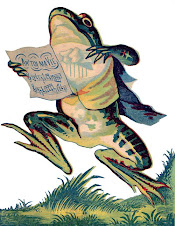
Annual Frog Count

Each spring volunteers tramp through the woods searching out vernal pool in order to record the numbers of frogs for the annual frog count. Data are collected using a calling survey technique, in which volunteers identify local amphibian species by their unique breeding vocalizations or calls.

You can go to The North American Amphibian Monitoring Program to sign up. According to the Burlington Free Press volunteers are especially needed to Count Frogs in Northern Vermont.

Volonteers needed to Count Frogs in Northern Vermont!

The North American Amphibian Monitoring Program is having a trouble finding volunteers in northern Vermont to help with the annual survey of frog populations.

Volunteers learn to recognize about a dozen different frogs by their spring calls, then go out on three evenings over three months to listen for the amphibians.

Scientists have been worried for a number of years about the global decline of frogs, salamanders and other amphibians — a puzzle that has been blamed on habitat destruction, disease, pesticide use and other possible causes.

Collecting background data on populations is an essential element in tracking species decline (or recovery) — the grunt work of science to which trained volunteers can contribute.

I’ll bet there are few Vermonters who can’t identify a spring peepers, but for the rest, the U.S. Geological Survey has excellent recordings of frog calls on line.

To learn more, go to www.pwrc.usgs.gov/naamp/index.cfm . If you’d like to enlist, send email to Vermont’s coordinator, Joe Przypek, jjprzypek@yahoo.com. Among the routes still available are ones in Starksboro, St. Albans, Barre, Ryegate and Topsham.

Sunday, February 28, 2010

Save The Frogs Day!

April 30, 2010 has been declared Save the Frogs Day!

Amphibians around the world are threatened with extinction. Save the Frogs Day will help to promote awareness of the plight of amphibians.

We encourage you to show your appreciation of frogs and all other amphibians by joining in celebrations all around the world.

In 2009, events took place in 15 countries, and Save The Frogs Day was legally recognized by the Governor of Virginia, the Mayor of Vancouver, British Columbia and the Chairman of Prince William County, Virginia.

You could suggest Save the Frogs Day Celebrations to your Boy or Girl Scout Troop, School Class, Homeschool Group, Science Club, Museum, Library or zoo. Please let us know how you will celebrate and who you will celebrate with.

It's time to Save the Frogs!

You will find dozens of frog related activities to get your children in the mood for Save the Frogs Day at Frog Unit Study: Hopping to Learn...

Friday, January 22, 2010

The Frog Pond in Winter

Walking down to the Frog Pond in WinterIt's the middle of the winter and the frogs are all tucked in beneath a blanket of mud. The frog pond is frozen over and the children wonder if the frogs could be frozen as well. Some children believe that the ice goes all the way to the bottom. Some believe that ice forms at the bottom of the pond first. Others believe that ice forms on top first. We decide to do an experiment.

1. Fill a clear shallow dish with water and place it in the freezer.
2. Set a timer to check it ever 1/2 hour. Check to see if it is starting to freeze. If so where is it starting to freeze?
3. I made a paper with an outline drawing of the bowl and a place to record the time when checked.

We discovered that ice formed around the edge first. We then noted that the ice covered the top of the water before it finally froze on the bottom. Would that be true of the frog pond?

We then decided to go down to the frog pond to check the ice there.

NOTE: I went over the safety rules for going out onto ice covered ponds.

We used a crowbar to make a hole in the ice. We discovered that the ice was 12 inches thick but that the water was not frozen below that.

The Story of Bremer Pond is an article about caring for fish in a pond during the winter. The children loved listening to the article and had many questions as well as suggestions for scientific experiments.

Be sure to check out lots more frog related activities from our Frog Unit Study.

When we came back from the pond each day, the children would write letters or notes to their penpals about their discoveries. Writing about their discoveries gives the children a purpose for writing. Receiving responses to their letters creates motivation for more observation and discovery.

Be sure to check out the new Frog Stamps on Zazzle.


Disclosure: I earn money from the sale of items on this page


create & buy custom products at Zazzle

Thursday, October 1, 2009

Going Down to the Frog Pond

Frog Pond

Photo Credit: Dick, Jane and Sally Go Down to the Frog Pond
on Flickr, Creative Commons.


There is nothing that children like more than to head down to the frog pond. We bring clear plastic jars, fish nets, eye droppers, magnifying glasses and guidebooks. We run and sing frog songs as we go but when we are approaching the pond we begin to tiptoe, hush our voices and look all around.

Sometimes we only see water striders on the surface and minnows swimming near the edge. But on special days we have seen wood ducks with their ducklings, tadpoles by the thousands and bullfrogs puffing out their throats calling out their deep-voiced Chug-a-rum!

We scoop up jars of water, catch a minnow or tadpole, sit down on the bank and start to observe. No matter how many times we go down to the frog pond there is something new to see. By careful observation we discover something we have never seen before.

That is the time that we begin to record our observations. We take photos with the digital camera, make carefully detailed drawings and write a through and detailed report of what we have seen.

These recordings are later made into books, poems, calendars, or card games so that we can share our information with others.

What do you do when you go down to the frog pond?

For lots more froggy activities go to Frog Unit Study

Friday, September 11, 2009

Review of My Side of the Mountain by Jean Craighead George

My Side of the Mountain (Mountain, Book 1) My Side of the Mountain by Jean Craighead George


My rating: 5 of 5 stars
My Side of the Mountain is one of the first books I remember reading as a child. Reading this book made me feel powerful. I made me feel that I was in control of my life and that I too could survive if I decided to go out into the woods on my own. All I needed was a few more survival skills.

My sister and I tried out many of the techniques that Sam Gribley mentions in My Side of the Mountain. I remember trying to make a rabbit snare. We spent hours and days trying to find a path in the grass where rabbits run. When we couldn't find that we decided to just try making the snare in preparation for the day that we found the rabbit run.

Time went on. We tried out many of Sam's ideas. We learned a lot about the woods and fields near our home. We never actually stayed out over night. When we were tired, home always seemed the best place to find a bed and hot food but we always knew that someday we could run away like Sam Gribley in My Side of the Mountain.

Read my expanded review of My Side of the Mountain>>

Thursday, September 3, 2009

Communication in the 18th Century


When you sit on the porch on the Garner Rix Farm you see the hay field and the flower beds, the hillside covered in trees and swallows swooping back and forth searching for insects on a warm summer day.

There are no houses in sight.

Though this may see isolated, the cell phone tower across the way provides excellent service, the mailbox is at the end of the five and a satellite dish points to the sky from the back of the woodshed.

But what was it like for Garner Rix when he was first clearing the land? I had always imagined that communication was difficult to impossible but when I took a second look I found evidence to the contrary.

My first hint was when I was talking with my next door neighbor. We were discussing what life was like before the Interstate came through. You see, the mountains form a valley that makes sounds easily carry. My neighbor says that at one time you could be working out in the hay field and listen to voices down in the village. You might not be able to understand what they were saying but you could hear them.

Intrigued, I listened for breads in the traffic to see if that was still possible.

Once a year the Royalton Town Band plays down in the village. I had planned to go down but was running late when there was a break in the traffic and all of a sudden I heard the band playing. Then there was the sound of clapping.This tells me that Garner Rix too was able to hear his neighbors.

He must have been able to hear his neighbors chopping down trees, splitting wood, calling to their oxen or the women calling the men in to dinner.

Another day I began reading a wonderful book, Look to the Mountain, by LeGrand Canon. This is a book about a young couple,k Whit and Melissa, who got married and moved from Connecticut to New Hampshire in about 1767 or around 20 years before Garner Rix's family moved up to the Grants, later know as Vermont.

Whit and his neighbors often walked 20 miles or more to help eachother during the pioneering process. By working together they got to know eachother's ways while exchanging news from the neighbors or from distant places such as Boston or England.

One day Whit could hear someone cutting trees. He knew form the direction of the sound which place it came from. By paying attention to the rhythm of the chopping he determined which of the three men living on that homestead we doing the chopping, another form of communication.

There was a time when letters traveled quickly in this country. Around 1900 you could put a letter in the mail with a message that you would be up to visit in the afternoon. What amazed me when I read postcards from this time period was that these messages traveled so quickly that the people who you planned to visit received it in time to prepare before the visitor arrived.

The mail system is now reverting back to what it was like in Garner Rix's time. A first class letter now takes 7-10 business days. The difference is that now it costs much more. In Garner Rix's time, anyone who traveled expected to carry letters that were going in his general direction. They would be passed from person to person, left at houses or stores when the traveler took a different direction and be picked up by the next person headed in the right direction.

If the message was urgent, neighbors might make a special trip to get the message through. Many forms of communication have changed since Garner Rix's time. Compare and contrast the various form of communication. Which time would you prefer to live in?

To learn more about Garner Rix, be sure to check out Garner Rix and the Royalton Raid.

This photo, Looking Across the Field can also be seen on RedGage